Introduction
Addison’s disease (also known as chronic adrenal insufficiency, hypocortisolism or hypocorticism) is a rare chronic disease affecting 4 in every 100,000 individuals in the UK. This condition can be diagnosed at almost any age and it is known to affect both men and women equally. Although this disease is an uncommon and potentially a life-threatening disease, treatments provided within today's society ensure that the majority of patients maintains a normal lifestyle and lifespan.
Although there is no cure, researchers have developed life-long steroid replacement therapies in order to reduce or eliminate the symptoms associated with the disease. These medications replace the missing hormones, that the individual can no-longer produce from the adrenal gland. 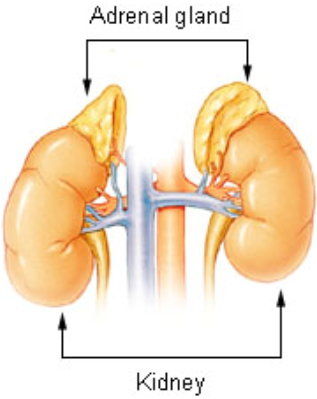
Addison’s disease can be defined as a primary insufficiencies (leading to hypofunction) caused by progressive destruction of the adrenal cortex. This destruction can result from numerous possibilities such as infection (e.g. tuberculosis), tumour or autoimmune adrenalitis.
This endocrine disorder is characterised by a deficient secretion of the hormones glucorticoid and mineralocorticoids. This leads to many common symptoms such as fatigue, muscle weakness, and weight loss. At high levels of circulating ACTH it can also lead to skin pigmentation. However due to the majority of its non-specific symptoms, patients suffering from Addison’s disease usally have to see two or more clinicians before being diagnosed with Addison’s disease. In fact, patients are usually ignored until a stressful event (like an illness or an accidence) causes their symptoms to exacerbate and become more noticeable.
Image of the adrenal glands and kidney courtesy of Wikimedia. These images are in public domain and thus free of any copy right restrictions.
Acute exacerbation of Addison’s disease is called an adrenal crisis. This condition has many causes; one possibility could be that the disease arose from previous undiagnosed Addison’s disease. In this condition, the amount of steroid hormones in the body falls leading to adrenal crisis. In untreated conditions this can be fatal.
Banner image courtesy of Flickr under creative commons license:
https://www.flickr.com/photos/marthajr/3467432932/sizes/l/
News
Boy died after 'failed diagnosis'
15/12/2009 04:16———
High-calorie Glucose-rich food attenuates neuroglycopenic symptoms in patients with Addison’s disease
04/12/2009 00:00———
Vitamin hope for Addison's patients
04/11/2002 00:01———