Overview
Thomas Addison first described the condition ‘On the constitutional and local effects of disease of the suprarenal capsule’ in 1849. Addison’s disease is a condition caused by destruction of the adrenal gland and the adjective ‘Addisonian’ is used to describes features of the disease. Addison’s disease is known to affect the production of two hormones cortisol and aldosterone, which have very important roles such as to help regulate blood pressure.
The Adrenal Glands
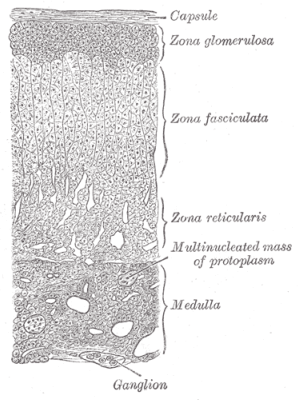
These are two small, triangular-shaped glands located superior to the kidneys, high up inside the back of the abdominal wall.
Each gland has an inner and outer layer that has separate roles:
· The inner are (the medulla) produces the hormone adrenaline
· The outer layer (the cortex) produces steroid hormones and small amounts of the male and female sex hormones, (called testosterone and oestrogen respectively).
The glands have numerous other functions such as; to help combat infections, control blood pressure and regulate the body’s salt and water balance; they do this by the production of hormones.
Cellular level image of the adrenal cortex courtesy of Wikimedia these images are in public domain and thus free of any copy right restrictions.
Cortisol (or hydrocortisone) and corticosterone
Is a member of the glucocorticoid hormone family, and is released in stressful situations and helps one to cope under these conditions, via stimulating a fight or flight response. It has many over roles such as:
· Maintains blood glucose
· Maintains blood pressure levels and heart functions.
· Suppresses the immune system
· Involved in controlling the metabolism of fats, carbohydrates and proteins
· Regulates inflammation and recovery from stress.
· Produces small amounts of the male and female sex hormones, testosterone and oestrogen respectively.
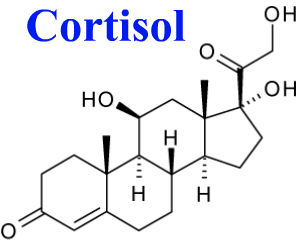
Chemical structure of cortisol courtesy of Wikimedia, these images are in public domian and thus free of any copy right restrictions.
Aldosterone
Is a group member of the hormone mineralocorticoids. Aldosterone maintains the balance of salt and water in the body by helping the kidneys keep hold of the sodium in the body whilst removing the potassium.
In Addison’s disease the cortex of both adrenal glands is destroyed subsequently destructing the production of steroid hormones (cortisol and aldosterone), this disruption of hormonal production causes chemical imbalances.
For instance if aldosterone fails to function properly: 
The volume of blood falls, leading to a blood pressure drop and dehydration, due to the inability to regulate salt and water balance.
The initial symptoms associated with Addison’s disease have many similar symptoms to other health conditions and are consequently misdiagnosed. Such conditions include depression, anorexia nervosa or gastrointestinal disorders resulting in inappropriate investigations and treatments.
Symptoms observed in Addison's disease develop slowly overtime (usually weeks or months).
These comprise of the following:
- Fatigue and lethargy
- Muscle weakness
- Weight loss –through loss of appetite
- Low blood sugar (hypoglycaemia) and low blood pressure (hypotension)
- Sweating (observed in rare occasions), need to urinate frequently, increased thirst
- Changes in mood and personality.
- Craving for salty food due to urinary losses of sodium.
These non-specific symptoms may increase in frequency and severity, alternatively individuals may also experience further symptoms such as:
Progressive symptoms
- Abdominal joint and back pain.
- Dizziness and fainting
- Nausea, vomiting diarrhoea
- Muscle cramps
- Postural/orthostatic hypotension (low blood pressure when you stand up).
- Chronic exhaustion which may cause depression/tearfulness
- Women may suffer from irregular periods
- Adrenal insufficiency is shown in the skin primarily by hyperpigmentation, particularly in the creases on your palm on scars or on pressure points such as knuckles.
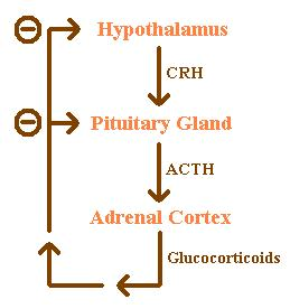
Bronzing of the skin colour has been thought to be due to primary hypocortisolism becoming apparent through deficiency in glucocorticoid (secreted from the adrenal gland); in response to this situation the pituitary gland releases high levels of ACTH in order to trigger release of the absent glucocorticoids.
Negative feed-back loop of glucocorticoids courtesy of Wikimedia, these images are in public domain and thus free of any copy right restrictions.
In about 25% of patients, symptoms first appear during an addisonian crisis. Patients with untreated Addison’s disease become progressively unwell with a reduced quality of life. Patients are at risk of developing serious acute adrenal crisis during intercurrent illnesses or stress. Adrenal crisis is a medical emergency and in this condition the symptoms of Addison’s disease are shown rapidly and severely.
The symptoms linked with adrenal crisis includes:
- Severe hypotension
- Severe dehydration
- Shock (when tissue/organs are incapable of receiving enough blood)
- Extreme muscle weakness
- Headache
- Severe vomiting and diarrhoea
- Extreme sleepiness, or coma
- Death